Between Taming and Moralizing: The "Sloterdijk Affair"
Mar 22, 2026
Human Condition
In this post, I explore Peter Sloterdijk's controversial "Rules for the Human Park" (Regeln für den Menschenpark, 1999), a lecture that ignited one of the most heated intellectual debates in postwar Germany. Sloterdijk's provocative meditation on humanism, domestication, and genetic selection raises unsettling questions: What technologies have shaped humanity? And who decides the "rules" for human improvement? A foundational text for understanding contemporary biopolitics. (work in progress).
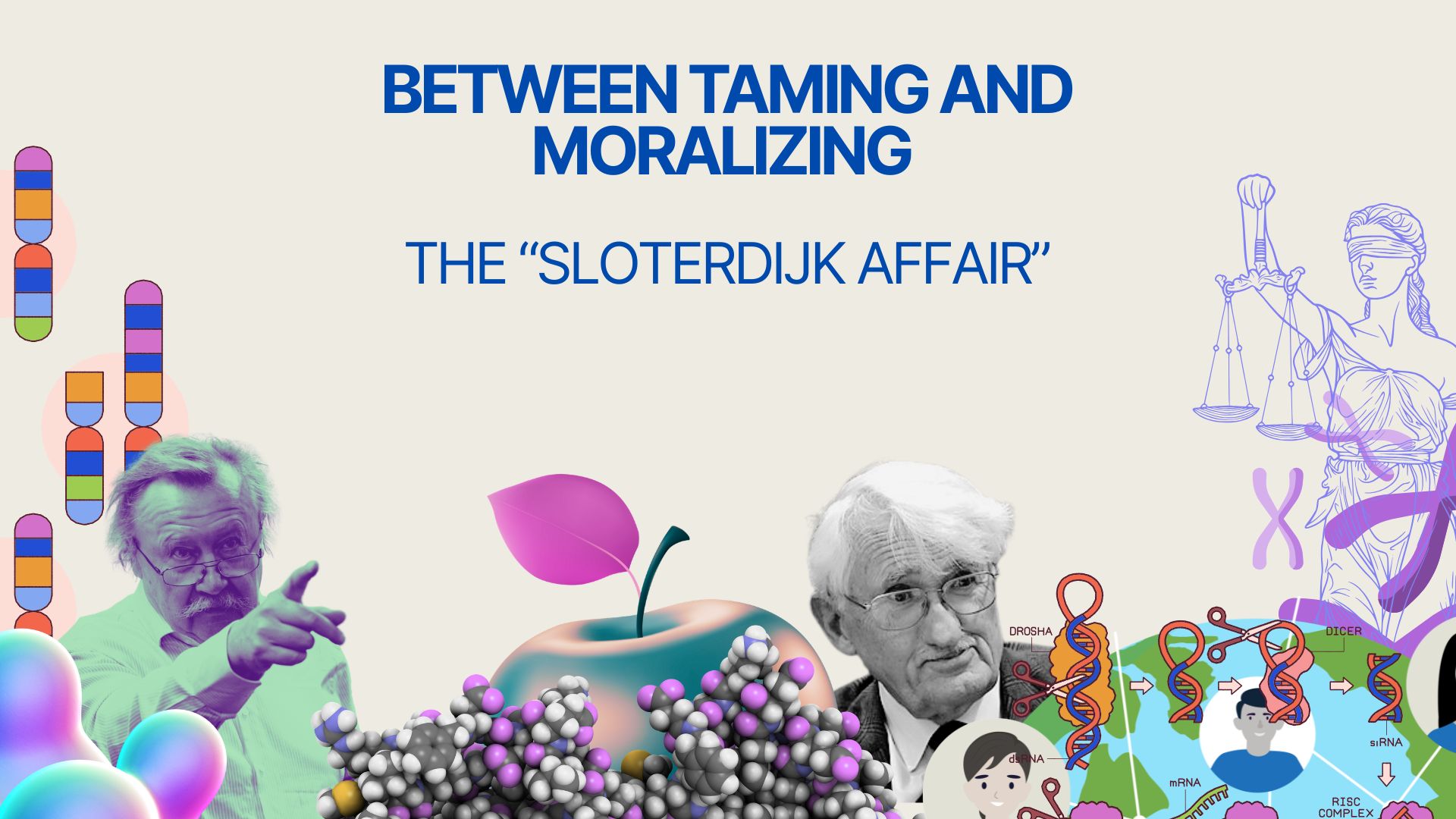
It all started in July 1999. Peter Sloterdijk delivered a lecture at Elmau Castle in Bavaria, titled Regeln für den Menschenpark (Rules for the Human Park), a first unsettling move that would spark outcry in German academia, known as the “Sloterdijk-Debatte.” Here, I analyze why both the form and the content of this debate matter to biojurists. My argument is not merely that this debate was philosophically significant, but that its very form, the way it was conducted, distorted, and ultimately foreclosed, illustrates the normative architecture (or lack thereof) of international biolaw. The procedural integrity of public deliberation, in the Habermasian sense, conditions the quality of the norms it produces at the legislative level. Where debate is bypassed or corrupted, ensuing legislation bears the traces of that evasion. Habermas developed this model with the democratic nation-state in mind, and he remained uncertain whether deliberative legitimacy could scale to post-national contexts. The "Sloterdijk affair" is instructive precisely because it shows how deliberative failure at the national level cascades at regional and international levels; it is a gap that Habermas's own framework cannot easily account for, and one that anyone concerned with the juridical fragmentation of the international biolegal order cannot afford to ignore. I started writing this post a few months ago and did not anticipate Habermas's recent passing. I therefore wish to emphasize that the present critique reflects a view on one very specific aspect of Habermas's philosophy, which I otherwise value immensely, particularly his contribution to legal scholarship and his approach to public deliberation.
1. The Lecture and Its Stakes
Sloterdijk's lecture was presented as a “response letter to Heidegger's Letter on Humanism” (1946), raising a simple question: if humanism was a project of domesticating the “human animal” through letters and literature (i.e., through Bildung), then what happens when the age of sophisticated literacy is over? Are there new techniques of human self-formation, and who oversees their implementation? The shift from literacy to a technological framing of the self was perhaps not the major bone of contention, but rather the vocabulary that Sloterdijk used deliberately. He operated a differentiation between Zähmung (taming, domestication) and Züchtung (breeding, selection), terms that are far from anodyne given Germany's history of eugenics. Sloterdijk, however, presented a philosophical diagnosis: humans had always engaged in both processes, through education, social or religious practices. His address was not prescriptive, but the wording conveyed an undeniable emotional resonance. To understand his contention, one must reframe it in the context of his research interests. Earlier, Sloterdijk had developed his renowned Sphären trilogy (1998–2004), where he argues that human existence is “spherological”: human beings live in protective enclosures, from their development in the uterus to architectural and immunological envelopes. Insulation is part of human civilization itself, Sloterdijk argues. Humans build insulated spheres, aim at controlling their climate, and overall generate their own environment. Humans, he contends, have never lived outside of their “anthropotechnical enclosures.” Contemporary biotechnologies therefore operate as a continuum of humanity's habitual way of living and developing. Anthropotechnics are part of hominization. This idea is not new: one finds the same co-evolutionary line in Leroi-Gourhan's anthropology [1] or Bertrand Gille's “history of technique” [2]. Yet Sloterdijk's approach is far from innocent: the choice of Heidegger as a point of intellectual departure is intentional. Heidegger is certainly a major philosopher of technology, yet he is also one who willfully contributed to the flourishing of a Nazi conception of academia, as the 1933 Rector's address makes plain. Sloterdijk then engages with Nicht gerettet: Versuche nach Heidegger (2001) and the notion of Lichtung (Heidegger’s concept of the clearing of Being), whereby beings come to presence. He re-interprets the concept through anthropotechnics: the Lichtung is a domesticated state, historically transmitted through cultural and increasingly biotechnological labor. It is worth noting here that the word “biotechnology” itself has a pastoral origin: Karl Ereky coined the term in a 1919 publication (Biotechnologie der Fleisch-, Fett- und Milcherzeugung im landwirtschaftlichen Großbetriebe) dealing with large-scale pig farming, that is, the agro-industrial optimization of animal life. One then understands why Sloterdijk's choice of words is anything but neutral: it borrows from the lexicon of breeding, while bearing in mind Germany's tortuous history with eugenics and population enhancement policies.
2. The Warped Foundations of the Argument
Prior to delving further into the argument, I wish to highlight an important point, pertaining to the turn this philosophical discussion has taken ensuing Sloterdijk’s first lecture in Basel (15 June 1997) and Elmau address in Bavaria (17 July 1999) on this subject. On 31 July 1999, a sensationalist account of Sloterdijk’s address appeared in the Frankfurter Rundschau[3], kindling a first wave of criticism. In a private correspondence dated 14 August 1999, Habermas expresses his doubts to Lutz Wingert: “What irritates me is the fascist core of a social-Darwinist appeal to breeding.”[4] Habermas then circulates Sloterdijk’s text among former students, as well as press contacts, without publishing a direct public critique at that stage. And, not long after, Thomas Assheuer publishes “Das Zarathustra-Projekt” in Die Zeit, presenting Sloterdijk’s work as a proto-fascist programme for the genetic modification of the human species.[5] Later, the polemic continues inflating in the German press while Habermas refrains from publishing a direct philosophical refutation, though he does eventually respond in the letter columns of Die Zeit.[6] Sloterdijk subsequently announces he retires from the German philosophical scene, a promise he did not keep. Let us pause here and reflect on the way such a striking absence of direct dialectics will impact the course of the debate (or absence thereof, so to speak). Habermas is known for having developed discourse ethics (Diskursethik), a theoretical framework premised on the very ideal of communicative rationality and the Diskurs as the legitimate arena for the resolution of normative conflict. Discourse ethics, as elaborated in Moralbewusstsein und kommunikatives Handeln (theory of communicative action) and refined through his engagement with Karl-Otto Apel’s transcendental pragmatics, holds that the validity claims embedded in “speech acts” are redeemable only through argumentative exchange, free from strategic distortion and from the subordination of communication to systemic imperatives of power or interest.One might, then, have expected a direct, public, and rigorously argued refutation of Sloterdijk's positions: a model instantiation of the very procedure Habermas spent decades theorizing.
What we witness instead is something altogether different: private correspondence, circulated manuscripts and intermediaries, including former students. A silence maintained in public fora while the polemic unfolds through informal networks. Assheuer's piece in Die Zeit did not emerge in a vacuum, it crystallized a charge: proto-fascism, Zarathustrean eugenics. It seems that Habermas, while a great theorist of the undistorted speech framework, chose a rather distorted form of communicative action, or a callous disregard.[7]
This is not a trivial observation. It is epistemologically consequential. For what is at stake is not merely a biographical inconsistency in the conduct of a philosopher, but a structural revelation about the actual conditions under which ideas are legitimized or delegitimized in the academic-thus-public sphere. The “Sloterdijk affair” does not simply illustrate a case of performative contradiction, it exposes the gap between the normative architecture of discourse ethics and its enactment in real life. Between the ideal speech situation as regulative idea and the very real speech situation as strategic field lies a chasm that cannot be overlooked. Whether Sloterdijk’s prose and semantic field is appropriate is one thing, yet the absence of an authentic discussion is another grave default, especially the absence of the benefit of the doubt. Sloterdijk was factually denied the possibility to explain himself with his detractors; an open discussion on eugenics would have also enriched the public debate. [8]
Sloterdijk’s work could as well be viewed as a diagnosis of the situation as regards the rebound of eugenics as an extension of liberalism – certainly provocative, yet perhaps not to the assertive extent of a full-fledged manifesto. Instead, Habermas published his own opus titled “The Future of Human Nature” (Die Zukunft der menschlichen Natur, 2001) against liberal eugenics. Habermas defends two connected claims. First, genetic self-transformation must remain subject to the norms of communicative ethics: it is permissible only if the person modified could, in principle, have consented, which is factually impossible in the case of germline gene editing. Second, the “ethics of the species” (Gattungsethik) requires preserving the moral self-understanding of humanity: the sense that we are beings who come into existence through natural processes, not as artefacts of parental choice. The moment we naturalize the idea that children are products to be designed, Habermas argues, we undermine the symmetrical relations between persons that underlie all valid norms. [9]
3. An Unfinished Debate for an Irredeemable Future?
The structural failure documented in the preceding section was not without consequences. Where deliberation is foreclosed, legislation fills the void, and it does so without the epistemological groundwork that genuine debate might have provided. At the very moment when Sloterdijk was stirring up German intellectual life with the vocabulary of Züchtung and Lichtung, the international community was constructing the normative architecture of modern biolaw. In his “Future of Human Nature,” Habermas observes that biotechnological progress induces a logic of “fait accompli,” in that scientific development often precedes reflexive thinking; and the same goes for law-crafting. Critiquing Buchanan’s (From Chance to Choice) and Dworkin’s (Sovereign Virtue (2000) and his essay “Playing God: Genes, Clones, and Luck”) liberal positions of genetic enhancement, Habermas does not directly respond to Sloterdijk’s controversial lecture, turning to the Anglo-American take on liberal eugenics. Once again, it seems that the Germano-German debate was left off the opus. This, perhaps, is one of the critical missing points of the academic management of the question of liberal eugenics, since Sloterdijk’s distasteful take, by using a conspicuous vocabulary, brought to the fore the shadow of national-socialist eugenics i.e., authoritarian eugenics, an issue that remains a taboo to this day. An open discussion on this topic would have perhaps been more useful to the human community than a lopsided discussion on liberal eugenics alone. That lack is visible in the way international instrument has been thus far crafted. The UNESCO Universal Declaration on the Human Genome and Human Rights (1997), the Council of Europe’s Convention on Human Rights and Biomedicine (Oviedo, 1997), and the EU Charter of Fundamental Rights (2000) are coeval with the Sloterdijk debate. This coincidence is instructive: not because biojurists “should have” read Sloterdijk, but because the absence of dialogue reveals something about the epistemological compartmentalization of international governance.
In parallel, international biolaw operates with science-laden norms: legal categories that silently import scientific representations through a one-dimensional format i.e., scientific language. Another beacon of biolaw is virtue-laden norms that emanate from the natural law tradition and Roman law tradition altogether. This is how one ends up reading international instruments gathering concepts such as “heredity,” “heritage” and “descendants” (emanating from family and inheritance law) with “genome” in the same provisions (emanating from the scientific sphere). For example, the Oviedo Convention prohibits interventions “seeking to introduce any modification in the genome of any descendants” (Article 13) and forbids use of reproductive technologies for “sex selection” except to avoid “a serious hereditary sex-related disease” (Article 14). The UNESCO Declaration proclaims that “in a symbolic sense, it is the heritage of humanity” (Article 1) “in a symbolic sense” being a remarkable qualification that reveals the declaration’s unease with its own metaphysics. Yet such texts do not mention any “ethics of the species” and remain bereft of genuine democratic debates on the subject. A few notable outcries, perhaps, may have stirred the public’s curiosity, as the uncanny “Raëlians” cloning claims in the 2000s, yet not followed by any public deliberation in the Habermasian sense. The “Sloterdijk-debatte,” seems to have remained rather local, European, and, above all, an internecine feud in academia. To prescind from this reality would be a naïve claim of academia’s real influence on law-crafting, but this question itself remains open. Francis Fukuyama’s take on similar questions in Our posthuman future (2002) constitutes a bioconservative counterpoint, though his “factor X” conception of human dignity, deliberately left undefined by Fukuyama himself, ultimately rests on an intuition rather than a justiciable norm.
What is also striking is that these instruments treat “the human genome” as a stable, knowable object, a natural fact that law can regulate without needing to examine how that fact is produced. Genetic engineering progressed at an accelerating pace, especially with the development of the germline gene-editing technique CRISPR-Cas9 by Professors Jennifer Doudna and Emmanuelle Charpentier (2012). The promising debate seemed to have fallen into oblivion while all prognoses were coming into reality. These academic (somewhat silent or epistolary) debates on such critical bioethical issues did not seem to yield any prescriptive guidelines that legislators could validly use to safeguard an international biolegal order.
In retrospect, one realizes that scientists may simply abscond from ethical guidelines since there are no effective controls over scientists once the lab is closed. The aura that scientists benefit from seems to be conducive to such liberal understanding of biotechnological progress. And reality imposed itself over the theoretical debate, less than twenty years after the famous affair. In November 2018, the Chinese biophysicist He Jiankui announced the birth of gene-edited babies, whose embryonic genomes he had edited using CRISPR-Cas9 to introduce a mutation in the CCR5 gene, purportedly to confer resistance to HIV. The announcement at the Second International Summit on Human Genome Editing in Hong Kong provoked immediate condemnation from the scientific community. He was subsequently sentenced to three years in prison in China (December 2019) for “illegal medical practice.” The affair is instructive for biolaw on several levels. First, it demonstrates that germline editing i.e., Sloterdijk’s scenario of Züchtung operating through molecular tools, is not a speculative horizon but a present reality. Second, it reveals the limits of existing regulatory frameworks: He Jiankui operated in the interstices between national regulations and international soft law, exploiting ambiguities in Chinese regulations on assisted reproduction. Third, and most significantly for our argument, the “Jiankui affair” produced an immediate proliferation of “principles” and “guidelines,” the WHO Expert Advisory Committee on Human Genome Editing issued two reports (2021), the Royal Society produced frameworks for governance, and the International Commission on the Clinical Use of Human Germline Genome Editing published its report (National Academies, 2020), all of which treat the genome as a stable object to be regulated, without examining how the concept of the human-genome-qua-text-to-be-edited might evolve in the future. Sloterdijk’s underlying question, namely who writes the rules for the park, was answered: committees of experts, convened in haste, producing soft-law instruments that will eventually harden into binding norms.
The contrast between the two affairs is, in the end, structurally revealing. The “Sloterdijk-Debatte” remained largely contained within German academic circles: a philosophical controversy that stirred intellectuals, generated press coverage, and then subsided without producing any prescriptive output legible to legislators. The “Jiankui affair,” by contrast, marked spirits precisely because it was irreversible. Children had been born. The laboratory had already closed. And yet, even here, the deliberative failure reproduced itself in a different register. He Jiankui did not act in a normative vacuum: prior to announcing his results, he had drafted what he presented as an ethical framework for his intervention, invoking principles of beneficence and informed consent in an attempt to pre-empt the charge of recklessness.[10] The gesture is philosophically significant: it suggests that the absence of a robust international biolegal order does not produce a normative void so much as a proliferation of self-authored ethical charters, each scientist becoming, in effect, the legislator of his own experiment.
This proliferation is compounded by the fragmentation of national frameworks. The resulting asymmetry does not merely reflect different national sensibilities; it generates the conditions for regulatory forum shopping, whereby research gravitates toward the most accommodating jurisdiction. He Jiankui’s operation in the interstices of Chinese regulation was not an anomaly but an extreme expression of a structural incentive that permissive national frameworks, however well-intentioned, quietly sustain.
What the two affairs share, separated by two decades, is the same foundational absence: a genuinely deliberated, epistemologically examined, and democratically grounded international biolegal order. Sloterdijk asked who writes the rules for the park. The answer, it turns out, is: whoever arrives first, equipped with a pipette and a self-drafted consent form. The disenfranchisement felt at the close of this analysis is not merely academic. It concerns the question of whether the human community retains any collective authorship over the conditions of its own reproduction, or whether that authorship has already, quietly, been abdicated.
Disclaimer
The opinions and views expressed here are solely my own and do not reflect the official policy or position of the University of Helsinki, its Faculty of Law, or any affiliated institution. This blog is a personal space for intellectual reflection and does not constitute legal advice or professional recommendation. All content is non-binding and subject to constant revisions and corrections. Biolaw can be a polarizing field: before sharing or commenting publicly and to avoid any confusion, please refer to the legal notice.
References
[1] Leroi-Gourhan, André. Le Geste et la Parole. 2 vols. Paris: Albin Michel, 1964–1965.
[2] Gille, Bertrand, ed. Histoire des techniques. Paris: Gallimard, Encyclopédie de la Pléiade, 1978.
[3] Mohr, Reinhard. “Züchter des Übermenschen.” Der Spiegel, Nr. 36, 1999. Assheuer, Thomas. “Das Zarathustra-Projekt.” Die Zeit, Nr. 38, 9 September 1999. https://homepage.univie.ac.at/henning.schluss/seminare/023bildung_und_genetik/texte/03assheuer.htm. Both reproduced in: Zeit-Dokument 2/1999. Frankfurt: Suhrkamp, 1999. https://petersloterdijk.net/werk/zeit-dokument-2-1999/
[4] This reference is yet to be confirmed. Habermas, Jürgen. Private letter to Lutz Wingert, 14 August 1999. Quoted in Stefan Müller-Doohm, Habermas: A Biography. Translated by Daniel Steuer. Cambridge: Polity Press, 2016, 314.
[5] Assheuer, Thomas. “Das Zarathustra-Projekt.” Die Zeit, Nr. 38, 9 September 1999. Fisher, Andrew. “Flirting with Fascism: The Sloterdijk Debate.” Radical Philosophy 099 (Jan/Feb 2000). https://www.radicalphilosophy.com/news/flirting-with-fascism-the-sloterdijk-debate
[6] Habermas, Jürgen. “Post vom bösen Geist.” Die Zeit, Nr. 38, 16 September 1999.
[7] Alliez, Éric, and Peter Sloterdijk. “Living Hot, Thinking Coldly: An Interview with Peter Sloterdijk.” Cultural Politics3, no. 3 (2007): 307–326.
[8] Sloterdijk, Peter. “Die Kritische Theorie ist tot. Offener Brief an Thomas Assheuer und Jürgen Habermas.” Die Zeit, Nr. 37, 9 September 1999. https://homepage.univie.ac.at/henning.schluss/seminare/023bildung_und_genetik/texte/04sloterdijk_an_%20assheuer_u_Habermas.htm. In: Cambridge Habermas Lexicon. Cambridge: Cambridge University Press, 2020.
[9] Habermas, Jürgen. Die Zukunft der menschlichen Natur: Auf dem Weg zu einer liberalen Eugenik? Frankfurt: Suhrkamp, 2001. Translated by William Rehg, Max Pensky, and Hella Beister as The Future of Human Nature. Cambridge: Polity Press, 2003. Mendieta, Eduardo. “Habermas on Cloning: The Debate on the Future of the Species.” Philosophy and Social Criticism 30, nos. 5–6 (2004): 721–743.
[10] [Reference to be confirmed.]